
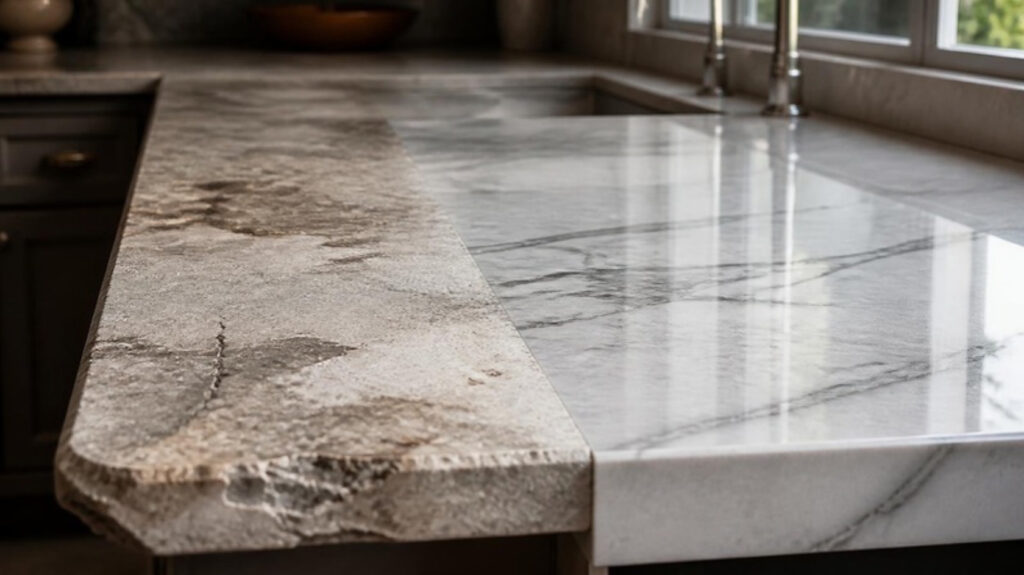
Damage that sits in the surface of a countertop can often be repaired. That covers a small chip, a stain, a light scratch or an etch mark. Replacement is the better choice when the damage reaches the core or the cabinets below, or when a crack keeps growing. It is also the answer when the material itself cannot be repaired.
This guide is for homeowners with a chipped, cracked, stained, burned or water-damaged countertop who are deciding between fixing it and replacing it. It covers laminate, solid surface, quartz, granite and other natural stone, and butcher block, and it leaves out prices. One point up front: UST Kitchen & Bath does not do repairs. Our work is kitchen and bathroom remodeling. Where a repair is the sensible answer, this guide says so and points you to a repair or stone restoration specialist.
Key Takeaways
- Surface damage (small chips, stains, light scratches, etch marks) is often repairable. Damage that reaches the core or the cabinets below, or a seam that has let water in, usually points to replacement.
- The material matters as much as the damage. Consumer Reports’ countertop guide (updated May 2025) says scratches and small nicks in solid surfacing can be buffed out. By the same guide, scratched or nicked laminate “can’t be repaired.”
- Chipped edges on quartz and granite need a professional repair, according to the same guide. Ask about that repair before you replace a whole slab.
- The Natural Stone Institute advises a professional stone restorer for etch marks and for deeper scratches and nicks in natural stone.
- Soft or swollen areas, a musty smell or stained cabinet panels suggest the problem is underneath. Find and fix the water source before you decide anything about the countertop.
- The U.S. Environmental Protection Agency says water-damaged areas should be dried within 24 to 48 hours to prevent mold growth.
- UST Kitchen & Bath does not do repairs, so get a repair opinion from a specialist when your damage falls in the repairable group.
In This Guide
- Which countertop damage can be repaired, and which points to replacement?
- How does the countertop material change the answer?
- What can a stone restoration specialist fix on natural stone?
- How do you know the problem is underneath the countertop?
- What to check before you decide
- When does replacement make more sense even if a repair is possible?
- Get a repair opinion first, then plan the replacement
- FAQ
Which countertop damage can be repaired, and which points to replacement?
Countertop damage is usually repairable when it is small, stable and limited to the surface. It points to replacement when it is spreading, structural or coming from below. Three questions sort nearly every case: how deep the damage goes, whether it is still changing, and whether the material allows a repair at all.
| Damage | Usually repairable? | When replacement makes more sense |
|---|---|---|
| Small chip on an edge or corner | Often, by a professional on stone and quartz | Several chips along the same edge, or a chip in laminate that exposes the core |
| Light surface scratches | Often on solid surface, natural stone and butcher block | Scratches in laminate, where the decorative layer is thin |
| Stain | Often on natural stone and butcher block, depending on the stain type | Deep rust stains in stone, or a stain that has gone through a worn laminate surface |
| Burn or scorch mark | Sometimes: in our reading, shallow marks on solid surface or butcher block can be sanded | A burn through laminate, or heat damage with a crack next to it |
| Hairline crack that is not growing | Sometimes, after a specialist has looked at it | A crack that lengthens, runs through a sink or cooktop cutout, or has one side sitting higher than the other |
| Lifted laminate edge or corner | Sometimes, if the core under it is dry and flat | The core under the lifted area is swollen, soft or crumbling |
| Opened seam | Sometimes, if both sides are still level and dry | The seam has let water in and the material beside it has swollen |
| Swelling or softness near the sink (laminate or wood) | Rarely | In most cases, after the leak is found and fixed |
Our summary, drawing on the Consumer Reports and Natural Stone Institute pages cited in the next two sections. Where a row goes beyond those pages, it is our reading. The table is a starting point for a conversation with a specialist and does not replace an inspection.
Read the table as a first sort, because the same word can describe very different problems. A “crack” in a stone slab may be a natural fissure that has been there since installation. It may also be a new break caused by movement in the cabinets. Only someone who can see and touch the countertop can tell those apart. That is why the “sometimes” rows all end with a specialist’s opinion.
How does the countertop material change the answer?
The countertop material sets the limit on what a repair can achieve. Some materials are the same all the way through, and others are a thin surface over a different core. A scratch that can be sanded out of one material is permanent in another.
Consumer Reports, an independent nonprofit organization that tests products, describes the repair behavior of each material in its countertop buying guide (updated May 22, 2025):
| Material | What Consumer Reports says about damage and repair |
|---|---|
| Laminate | “Laminate is easily scratched and nicked and can’t be repaired.” It also warns: “Water can seep through seams or between the countertop and backsplash, weakening the material.” |
| Solid surfacing | “Scratches and small nicks can be buffed out and repaired. The material is waterproof.” It also “scratches and cuts easily.” |
| Quartz | “Edges and corners can chip, and only a pro can repair them.” |
| Granite | “Edges and corners can chip and you’ll need a pro to repair them, and granite needs periodic sealing for stain protection.” |
| Butcher block | “relatively easy to install and repair”, but “damage from heat, cuts, scrapes, and impacts makes for high maintenance.” |
Source: Consumer Reports, Countertop Buying Guide, updated May 22, 2025.
Laminate is the clearest case for replacement. A laminate countertop is a thin decorative sheet bonded to a wood-based core, so there is little material to sand or polish. The guide’s warning about water at the seams matters most near the sink, where the countertop gets wet most often. In our reading, cosmetic patching products for laminate exist, but they cover a mark and do not restore the surface.
Solid surface and butcher block sit at the other end. Both are the same material through their full thickness, so scratches can be buffed or sanded out before the surface is refinished. In our reading, the same goes for shallow burns. Quartz and granite fall in between. A chipped edge is a job for a professional, and a good repair can make replacing a whole slab unnecessary.
One gap should be stated plainly. The published guidance cited here does not describe how well heat marks or cracks in quartz can be repaired. This guide therefore makes no claim about them. If that is your damage, ask a repair specialist to look at it before you decide.
What can a stone restoration specialist fix on natural stone?
A stone restoration specialist can often remove stains, repolish etched or dull areas, and repair deeper scratches and nicks in natural stone. The Natural Stone Institute, the industry association for natural stone, sets this out in its care and cleaning guidance. Several of the fixes it describes are within a homeowner’s reach. Read the Institute’s full instructions and warnings on that page before trying any of them. Its warnings include “Do not mix ammonia and bleach,” and it advises rubber gloves, eye protection and a well-ventilated work area.
| Problem on natural stone | What the Natural Stone Institute advises |
|---|---|
| Oil-based stain (grease, cooking oil, cosmetics) | The stain darkens the stone and “normally must be chemically dissolved”; clean gently with household detergent, mineral spirits or acetone |
| Organic stain (coffee, tea, wine, fruit, food) | Indoors, clean with 12% hydrogen peroxide and a few drops of ammonia |
| Rust or metal stain | “Must be removed with a poultice”; deep-seated rust stains “are extremely difficult to remove and the stone may be permanently stained” |
| Water spots and rings | Buff with dry 0000 steel wool |
| Etch marks | Contact a stone dealer or “a professional stone restorer for refinishing or repolishing etched areas” |
| Scratches and nicks | Slight scratches may be buffed with dry 0000 steel wool; deeper ones “should be repaired and repolished by a professional” |
Source: Natural Stone Institute, Care and Cleaning of Natural Stone. The page shows no publication date; accessed October 2026.
For a stone countertop, this list means that a stain or a dull patch is rarely a reason to replace the slab by itself. An etch mark is a dulled patch in the finish. The Institute says etching is caused by acids left on the surface of the stone. Products with lemon, vinegar or other acids can dull or etch calcareous stone, which is made mainly of calcium carbonate. Repolishing addresses exactly that. Stone restoration is a skilled trade, and for this kind of damage it is the right first call.
The same guidance also shows where repair stops. A deep rust stain may be permanent. The Institute also notes that sealing “does not make the stone stain proof”, so a restored surface can stain again. If a stone countertop has several permanent stains and a damaged edge together, compare the specialist’s answer with what a new countertop would give you.
How do you know the problem is underneath the countertop?
The problem is underneath the countertop when the surface damage is a symptom of water, movement or decay below it. In that case, fixing or replacing the top alone does not solve anything, because the cause is still active.
Look for these signs, starting around the sink and the dishwasher:
- The countertop feels soft or spongy when pressed, or the surface has risen into a bump or ridge.
- A seam or the front edge has swollen and no longer sits flat.
- The cabinet floor under the sink is stained, warped or damp, or the cabinet side panels have swollen at the bottom.
- There is a musty smell inside the sink cabinet.
- Cabinet doors under the damaged area no longer line up, which can mean the cabinet box has moved.
- A crack in a stone or quartz top has one side higher than the other.
- A gap has opened between the countertop and the wall.
The U.S. Environmental Protection Agency covers this in A Brief Guide to Mold, Moisture and Your Home, last updated February 18, 2026. The guide states that “the key to mold control is moisture control.” It advises fixing plumbing leaks “as soon as possible.” It says it is important to dry water-damaged areas and items “within 24-48 hours to prevent mold growth.” It also notes that absorbent or porous materials “may have to be thrown away if they become moldy.”
The EPA guide gives ceiling tiles and carpet as its examples and does not mention countertops. In our reading, a wood-based countertop core or cabinet floor is also an absorbent material, so the same caution applies if it becomes moldy. The practical order is the same in every case: stop the leak, dry the area, and then judge what is left.
The guide also sets a size threshold. Above about 10 square feet of mold, or after a lot of water damage, it refers readers to a separate EPA guide on mold remediation. If you hire a contractor for the cleanup, the EPA advises making sure the contractor has experience cleaning up mold.
What to check before you decide
Checking six things before you call anyone makes the repair or replace decision faster. You need nothing more than a flashlight, a level and a tape measure.
- Identify the material. Look at the underside of the overhang or inside the sink cabinet. A wood-based core under a thin surface layer indicates laminate. Stone, quartz and solid surface are one material through their full thickness.
- Empty the sink cabinet and look at the floor, the back panel and the pipes. Run the faucet and the dishwasher, then check for drips at the supply lines, the drain and the faucet base.
- Press on the countertop around the sink, the seams and the damaged spot. Note any area that gives or feels raised.
- Measure the damage and mark the ends of any crack with a pencil and the date. If you can wait, check it again after a couple of weeks to see whether it has grown.
- Lay a level or a straight board across seams and cracks to see whether both sides sit at the same height.
- Take photos. You need one of the whole countertop run and one close-up of the damage with a coin or ruler for scale. Add one of the cabinet interior below it.
If step 2 or step 3 turns up a leak or a soft spot, the EPA advice in the previous section comes first. Fix the leak as soon as possible and dry the area within 24 to 48 hours. If step 4 shows a crack that has grown past your pencil marks, treat it as moving damage. In the first table of this guide, that points to replacement.
With those notes, you can ask a repair specialist whether a visit is worthwhile. The same notes help in a first conversation about replacement. Add the length and depth of each countertop section and the position of the sink and cooktop.
When does replacement make more sense even if a repair is possible?
Replacement makes more sense than a possible repair in three situations. The repair would be visible in a place that matters to you, the damage keeps returning, or the countertop is about to change anyway. A technically successful repair is not the same as a result you will be content to look at every day.
| Your situation | What usually fits | Why |
|---|---|---|
| One small chip or stain on an otherwise sound stone or quartz top | Repair by a specialist | The damage is local and the rest of the slab has years of use left |
| Scratches or a shallow burn on solid surface or butcher block | Repair or refinishing | Scratches can be buffed or sanded out of a material that is the same throughout; for a shallow burn this is our reading |
| Laminate with a burn, deep scratch or exposed core | Replacement | Consumer Reports says scratched or nicked laminate can’t be repaired; for burns and an exposed core this is our reading |
| Swelling near the sink, with or without a leak you have found | Fix the leak, then replacement | In our reading, a swollen wood-based core does not return to flat |
| A repair has already been done once and the damage has come back | Replacement, after the cause is found | Recurring damage suggests a cause that the repair did not remove |
| You are already planning new cabinets or a new sink layout | Replacement | A countertop is cut to the cabinets and cutouts it sits on |
Our summary of the reasoning in this guide. Individual cases differ, and a specialist’s inspection outweighs this table.
Appearance is a fair reason too. A filled chip in a patterned stone can be hard to spot. A repaired crack across the middle of a plain, light-colored top may stay visible. Ask the repair specialist what the finished result will look like and whether you can see photos of comparable work.
This guide has limits. It cannot assess your countertop. It leaves out prices because they vary by region and date, and it does not cover tile, concrete or stainless steel. It also does not cover resurfacing coatings or overlays, which are a separate option to ask a refinishing specialist about. Finally, it cannot tell you whether a matching piece of your existing material is still available. That matters if only one section is damaged.
Get a repair opinion first, then plan the replacement
Start with the cause and the depth of the damage. If the damage is on the surface and the material allows it, ask a repair or stone restoration specialist first. For natural stone, the Natural Stone Institute refers etch marks and deeper scratches to a professional stone restorer. If the core is swollen, a crack is growing, the laminate is burned through or the cabinets below are affected, fix any leak first. Then look at replacement options. Where damage has come back after an earlier repair, find the cause before you choose either path.
UST Kitchen & Bath has a showroom in Richardson, Texas, and our team brings over 30 years of experience to kitchen and bathroom projects. We do not repair countertops. Our work is kitchen and bathroom remodeling.
Contact UST Kitchen & Bath about your kitchen or bathroom project
Frequently Asked Questions
Can I replace only the damaged section of a countertop?
Sometimes, if the countertop is made of separate sections with seams between them. The difficulty is matching. Natural stone varies from slab to slab, and colors and patterns of manufactured materials can be discontinued. Ask whether a match is available before you plan around a partial replacement.
Does a new countertop mean I need new cabinets?
No, a countertop can be replaced on existing cabinets when the cabinet boxes are level, dry and solid. Cabinets that have swollen or shifted from water damage need to be repaired or replaced first, because the new top will rest on them.
Should I seal a granite countertop again after a stain is removed?
Sealing is worth discussing with the specialist who removes the stain. The Natural Stone Institute states that sealing makes stone more stain resistant and does not make it stain proof. It also advises a non-toxic sealer that is safe for food preparation areas.
Sources
- Natural Stone Institute, Care and Cleaning of Natural Stone. Industry association for natural stone; stain types and treatment, etch marks, scratches and nicks, sealing, safety warnings. No publication date shown; accessed October 2026.
- U.S. Environmental Protection Agency, A Brief Guide to Mold, Moisture and Your Home, last updated February 18, 2026. Government agency; moisture control, 24 to 48 hour drying window, porous materials, 10 square foot threshold, choosing a cleanup contractor.
- Consumer Reports, Countertop Buying Guide, updated May 22, 2025. Independent nonprofit organization that tests products; repair behavior of laminate, solid surfacing, quartz, granite and butcher block.