
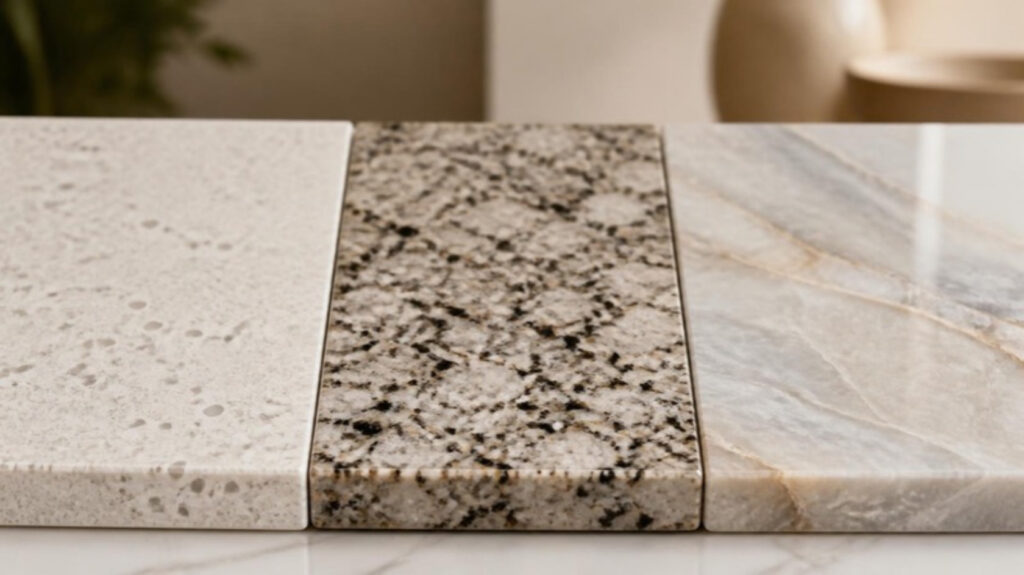
Quartz is a manufactured surface made of crushed mineral and resin, while granite and quartzite are natural stones cut from the earth. If you want a uniform pattern and no sealing, look at quartz first. If you want a one-of-a-kind slab, look at granite or quartzite. On heat, the published sources disagree, so a trivet is the safe habit on all three.
This guide is for homeowners who are replacing kitchen countertops and have heard these three names without a clear explanation of how they differ. It covers what each material is made of, heat, staining, sealing, scratches, appearance, cleaning, slab size and seams. It leaves out prices, which change too quickly for a guide meant to last. It also does not cover marble, solid surface, laminate or porcelain.
Key Takeaways
- Quartz countertops are engineered: crushed quartz bound with resin. Granite and quartzite are natural stones, and quartzite is a different material from quartz despite the similar name.
- A 2019 article from a natural stone trade association calls resin the weak point of engineered quartz for heat and direct sunlight. In an independent buying guide, quartz and granite both earned top scores with hot pots.
- Engineered quartz does not require sealing. Granite is porous and is commonly sealed, and some quartzites benefit from sealing while others do not.
- Sealing makes stone more stain resistant, not stain proof. In a 2019 stain test, engineered quartz was also stain resistant, not stain proof.
- Some stone sold as quartzite is marble or dolomitic marble. Real quartzite scratches glass and does not etch when lemon juice or vinegar sits on it for about 15 minutes.
- Natural slabs differ from one another, so choose the actual slab. Engineered quartz is more uniform, which can make a sample a closer guide to the finished counter.
- Have countertop measurements and photos of the kitchen ready when you compare materials in person.
In This Guide
- What is the difference between quartz, granite and quartzite?
- Why do quartz and quartzite get confused?
- How do the three handle heat, stains and scratches?
- Which countertops need sealing, and how are they cleaned?
- How do pattern, slab size and seams differ?
- Which countertop fits which situation?
- What to ask in a countertop showroom
- Measure, photograph, then compare slabs in person
- FAQ
What is the difference between quartz, granite and quartzite?
Quartz, granite and quartzite differ first in where they come from. A quartz countertop is made in a factory, while granite and quartzite are quarried rock. That single difference explains much of what follows about heat, sealing and pattern, so it is worth getting straight before comparing anything else.
Granite is an igneous rock. The U.S. Geological Survey (USGS) explains that igneous rocks form when hot, molten rock crystallizes and solidifies. It lists granite among the common intrusive igneous rocks, the kind formed from magma trapped deep inside the Earth. Quartzite is a metamorphic rock. The USGS page on metamorphic rocks (updated September 9, 2026) says these rocks started as another type of rock. They were transformed, without melting, into denser and more compact rock, and the page lists quartzite among the common examples.
Engineered quartz is a manufactured slab. A 2019 article on the Natural Stone Institute’s consumer site looks at what goes into it. It reports that manufacturers often describe the mix as 93 percent mineral quartz and 7 percent binder. The same article points out that this ratio is calculated by weight, so the finished product may consist of 30 to 40 percent resin. We cannot verify the recipe of any specific brand, so ask for the product’s technical sheet.
| Quartz (engineered) | Granite | Quartzite | |
|---|---|---|---|
| What it is | Manufactured slab of crushed quartz and resin | Natural igneous rock | Natural metamorphic rock formed from sandstone |
| Pattern | More uniform from slab to slab | Each slab differs in color and pattern | Each slab differs in color and pattern |
| Heat | Rated below natural stone by a trade association; top scores with hot pots in independent testing | Handles heat well; trivets still recommended | Natural stone; trivets still recommended |
| Sealing | Not required | Commonly sealed | Depends on the specific stone |
| Stains | Stain resistant, not stain proof | Porous; sealing improves resistance | Varies with how dense the stone is |
| Main caution | Direct sunlight, abrasive cleaners | Sealing and slab-to-slab variation | Mislabeled stone |
Our summary of the sources cited in the sections below. A specific product or slab may behave differently.
Why do quartz and quartzite get confused?
Quartz and quartzite get confused because both names come from the same mineral, yet one is a factory product and the other is a rock. The mineral quartz is the main ingredient in each. In an engineered slab it is ground up and bound with resin. In quartzite, natural heat and pressure fused it grain to grain.
Geologist Karin Kirk wrote about quartzite for the Natural Stone Institute’s consumer site in January 2017. She describes sand grains that were compressed into sandstone. With enough heat and pressure underground, those grains fused to their neighbors into a dense, durable rock. The Institute’s technical page on sandstone and quartzite also calls quartzite a metamorphic rock formed from sandstone. It adds that the stone can be of exceptional strength, density and hardness. No resin is involved, so in our reading the heat and sunlight cautions that apply to engineered quartz do not carry over to quartzite.
A second confusion sits inside the stone trade itself. Kirk’s article states that quartzite is commonly mislabeled, and that marble or dolomitic marble is sometimes sold under that name. Marble is softer and reacts to kitchen acids, so a mislabeled slab can behave very differently from what the buyer expected. Kirk describes two simple checks:
| Check | What real quartzite does | What it tells you |
|---|---|---|
| Scratch a piece of glass with an edge of the stone | Scratches the glass easily; you can hear and feel it bite | The stone is harder than glass, as quartz is (7 on the Mohs hardness scale) |
| Leave lemon juice or vinegar on a sample for about 15 minutes, then wipe it off | Shows no etching | The stone does not contain the acid-sensitive minerals found in marble |
Source: Karin Kirk, “The Definitive Guide to Quartzite”, Use Natural Stone (Natural Stone Institute), January 24, 2017.
Run these checks on a loose sample or an offcut, with the seller’s permission, and not on a finished slab face. If a seller describes a stone as “soft quartzite”, treat that as a reason to test: Kirk’s article says there is no such thing.
How do the three handle heat, stains and scratches?
The sources agree more on staining than on heat, and all three surfaces can stain or be damaged under the wrong conditions. The differences come from the resin in quartz and from the porosity of natural stone.
On heat, Stephanie Vierra wrote a July 2019 article on the Natural Stone Institute’s consumer site. She states that engineered quartz is not as resistant to heat as natural stone. She adds that the resin raises the risk of damage and discoloration from heat and light. The same article describes granite as easily handling hot pots and pans.
Independent testing gives a different picture for quartz. Consumer Reports rates countertops on stains, abrasion, cutting, heat and impact. Its countertop buying guide (updated May 22, 2025) says quartz “survived spills, hot pots, knives, and more with top scores” in its tests. It says the same of granite. The guide does not cover quartzite.
The Institute’s own care guide is cautious about stone in general. It says that while many stones can withstand heat, the use of trivets or mats is recommended. With the sources split on quartz, a trivet is the sensible habit on all three surfaces.
On staining, Kirk tested engineered quartz samples in 19 colors for a June 2019 article. She concluded that the material is stain resistant, but not stain proof.
| Finding from the test | Detail |
|---|---|
| What stained | Food coloring, turmeric, hot sauce and permanent marker; food dye left a stain on most samples |
| Which colors showed it | Lighter colors showed discoloration more visibly |
| Abrasive cleaning | Lightened stains without removing them, and damaged the finish |
| Why | As much as 25 percent or more of the slab’s surface area is resin, which is softer than the quartz particles |
Source: Karin Kirk, “Do Engineered Quartz Countertops Stain?”, Use Natural Stone (Natural Stone Institute), June 28, 2019. The test covered engineered quartz only.
On scratches, Kirk’s quartzite article rates mineral quartz at 7 on the Mohs hardness scale. That is harder than glass and harder than a knife blade. It applies to quartzite and to the quartz particles in an engineered slab. The resin between those particles is softer, and Vierra’s article adds that engineered quartz can chip and is harder to repair than natural stone.
Consumer Reports notes that edges and corners of both quartz and granite can chip, and that repairs need a professional. Beyond its knife results, we did not find a non-commercial source with a hardness figure for granite as a countertop. This guide therefore does not rank granite against the other two on scratching.
One caution about these sources: the Natural Stone Institute is a trade association for natural stone. Its comparisons with engineered quartz therefore come from an interested party. The independent guide cited above is the counterweight, but it covers quartz and granite only. As of October 2026 we did not find an independent test that includes quartzite.
Which countertops need sealing, and how are they cleaned?
Engineered quartz does not require sealing, granite is commonly sealed, and quartzite depends on the individual stone. Vierra’s 2019 article describes granite as porous and says that sealing with a penetrating sealer is a common option. By the same article, engineered quartz is less porous and does not require it. The Consumer Reports guide agrees on both points. Kirk’s quartzite article notes that some quartzites are tightly bonded and others will benefit from sealing.
The Natural Stone Institute’s care guide explains what sealing does and does not do. The products used are impregnators, which act as repellents. In the Institute’s words, sealing “does not make the stone stain proof, rather it makes the stone more stain resistant.” The guide also says that many stones do not require sealing, and it gives no fixed schedule. It directs owners to the supplier or the sealer manufacturer for how often to reapply.
| Care point | What the Natural Stone Institute advises for natural stone |
|---|---|
| Routine cleaning | A neutral cleaner, stone soap, or mild liquid dishwashing detergent and warm water |
| Acids | Products containing lemon, vinegar or other acids may dull or etch calcareous stones; siliceous stone is generally resistant to most acids found in kitchens, but acidic cleaners are still not recommended |
| Abrasives | Scouring powders or creams may scratch certain stones |
| Heat | Trivets or mats are recommended |
| Drinks | Coasters under glasses, particularly with alcohol or citrus juices |
Source: Natural Stone Institute, “Care & Cleaning of Natural Stone” (undated web page, accessed October 2026).
Siliceous stone, in the Institute’s definition, is composed mainly of silicates such as quartz, feldspar and mica. In our reading that description covers granite and true quartzite, which makes kitchen acids a smaller concern for them than for marble. For engineered quartz, the stain test described above points to a mild approach with non-abrasive cleaners, because abrasive cleaning damaged the finish. The product manufacturer’s care instructions take priority over any general guide, including this one.
How do pattern, slab size and seams differ?
Granite and quartzite vary from slab to slab, while engineered quartz is more uniform because it is manufactured. Vierra’s article puts it this way: every slab of granite is slightly different in color and pattern, and engineered quartz is more uniform in appearance. Quartzite, as a natural stone, varies in the same way granite does.
That difference changes how you should shop. With natural stone, a small sample shows the general color, but the veining and movement of your countertop come from one specific slab. Ask to see that slab and, where possible, have it reserved by its identifying number. In our reading, a sample is a closer guide with engineered quartz. A strongly veined quartz design can still look different across a full counter than on a hand-sized piece.
Seams depend on slab size and on your layout. A counter run longer than the slab, an L-shaped corner or a large island may need a joint, in any of the three materials. A uniform pattern is likely to make a seam easier to disguise. A slab with strong directional veining needs more planning so the pattern lines up across the joint.
We did not find non-commercial guidance on standard slab dimensions, which differ by product and by quarry. This guide therefore gives no numbers. Ask for the slab size and a seam drawing before you approve a layout.
Which countertop fits which situation?
Match the material to the way your kitchen is used and to how much variation and upkeep you are comfortable with. No one of the three is right for every kitchen, and each has a condition under which it is the weaker choice.
| Your situation | What usually fits | Why |
|---|---|---|
| You want the counter to look like the sample, with a consistent pattern | Quartz | A manufactured slab is more uniform |
| You do not want to seal a countertop | Quartz | Sealing is not required |
| A counter sits in strong direct sunlight | Granite or quartzite | Resin in engineered quartz can fade or yellow in sunlight, according to a trade association article |
| You often set down hot cookware | Any of the three, with a trivet | The sources disagree on quartz, and the stone care guide recommends trivets for stone too |
| You want a slab that no other kitchen has | Granite or quartzite | Each natural slab differs in color and pattern |
| You want a light, veined natural stone and worry about acid etching | Verified quartzite | Real quartzite does not etch from lemon juice or vinegar |
| You cook often with turmeric, food dyes or hot sauce and prefer a light color | Any of the three, with care | Quartz stained in testing, and natural stone depends on porosity and sealing |
Our summary, based on the sources cited in this article.
This comparison has limits. It describes each material in general, and individual products and slabs vary. One granite can be much more porous than another, and engineered quartz formulas differ between manufacturers. Much of its evidence on engineered quartz comes from a natural stone trade association. It also leaves out cost, availability and installation, which can outweigh the differences described here. Treat the table as a way to narrow the choice to one or two materials. Then judge the specific slab or product in front of you.
What to ask in a countertop showroom
A showroom visit is most useful when you arrive with your own numbers and a short list of questions. Have ready the length and depth of each countertop run and the size of the island if there is one. Note the positions of the sink and cooktop, and take photos of the kitchen that show the cabinets, floor and window light.
Ask these questions about each material you are shown, before you approve a layout or place an order:
- Is this engineered quartz or natural stone, and if it is natural, what is the stone’s geological name?
- If it is labeled quartzite, may I test a sample on glass and with lemon juice?
- Does this surface need sealing, and if so, with which product and how often?
- What does the manufacturer or supplier say about hot cookware and direct sunlight?
- Which cleaners are approved, and which ones void the warranty?
- Can I see and reserve the actual slab that will be used in my kitchen?
- How large is the slab, and where would the seams fall in my layout?
- Who takes the final measurements, and who installs the countertop?
- What does the warranty cover, and for how long?
Ask for the sealing, care and warranty answers in writing, and note the rest for each material. Side by side, they show which differences matter in your own kitchen and which ones only matter on paper.
Measure, photograph, then compare slabs in person
Decide in this order: first engineered or natural, then which natural stone, then which slab. If consistency and no sealing matter more to you, start with quartz. If a unique slab matters more, or the counter sits in strong direct sunlight, start with granite or quartzite. Confirm that anything sold as quartzite passes the glass and acid checks.
Whichever material you choose, the care basics in this guide overlap. Use a trivet under hot cookware, clean with a neutral cleaner, and avoid abrasive pads and powders. Follow the manufacturer’s or supplier’s instructions on sealing and care. Then put the nine questions above to every showroom you visit.
UST Kitchen & Bath has a showroom in Richardson, Texas, and our team brings over 30 years of experience to kitchen and bathroom projects.
Contact UST Kitchen & Bath about your kitchen countertops
Frequently Asked Questions
Can quartz countertops be used outdoors?
Not without checking the manufacturer’s terms first, because direct sunlight is a known risk for engineered quartz. Vierra’s 2019 article on the Natural Stone Institute’s consumer site says the material can begin to fade or turn yellow within weeks of direct sunlight. The same article, published by a natural stone trade association, says natural stone does not fade this way. Check the warranty terms before using any quartz product outside.
Are granite countertops radioactive?
Granite can contain traces of radioactive elements, but the U.S. Environmental Protection Agency (EPA) says countertops are extremely unlikely to raise radiation doses above normal. Its page on granite countertops and radiation was updated January 12, 2026. If uranium, thorium or radium are present, they decay into radon, a colorless, odorless radioactive gas. The EPA recommends testing all homes for radon, regardless of whether the home has granite countertops.
Is the dust from cutting countertops a concern?
For the people cutting the stone, yes. Cutting stone releases crystalline silica, which the Occupational Safety and Health Administration (OSHA) treats as a workplace hazard. OSHA states that stone and artificial stone contain crystalline silica. It has issued a hazard alert on worker exposure during countertop manufacturing, finishing and installation. OSHA’s guidance addresses workers, not homeowners, so ask your fabricator how cutting is handled.
Sources
- U.S. Geological Survey, “What are metamorphic rocks?”, FAQ page, updated September 9, 2026. Government agency; definition of metamorphic rock and quartzite as an example.
- U.S. Geological Survey, “What are igneous rocks?”, FAQ page, accessed October 2026. Government agency; definition of igneous rock and granite as an intrusive example.
- U.S. Environmental Protection Agency, “Granite Countertops and Radiation”, web page, updated January 12, 2026. Government agency; radioactive elements in granite and radon testing.
- Occupational Safety and Health Administration, “Silica, Crystalline: Overview”, accessed October 2026. Government agency; crystalline silica in stone and artificial stone, worker exposure.
- Consumer Reports, “Countertop Buying Guide”, by Tanya A. Christian with lab testing by Paolo Fu, updated May 22, 2025. Independent tester; test results for quartz and granite, sealing and chipping.
- Natural Stone Institute, “Care & Cleaning of Natural Stone”, undated, accessed October 2026. Trade association; sealing, cleaning, heat and acid guidance.
- Natural Stone Institute, “What Is Sandstone and Quartzite? Technical Data and Best Practices”, undated, accessed October 2026. Trade association; definition of quartzite.
- Karin Kirk, “The Definitive Guide to Quartzite”, Use Natural Stone (Natural Stone Institute), January 24, 2017. Trade association consumer site; formation, hardness, mislabeling and identification tests.
- Karin Kirk, “Do Engineered Quartz Countertops Stain?”, Use Natural Stone (Natural Stone Institute), June 28, 2019. Trade association consumer site; staining and cleaning test on engineered quartz.
- Stephanie Vierra, “Granite vs. Engineered Quartz for Your Kitchen Countertop”, Use Natural Stone (Natural Stone Institute), July 31, 2019. Trade association consumer site; composition, heat, sunlight, sealing and appearance.