
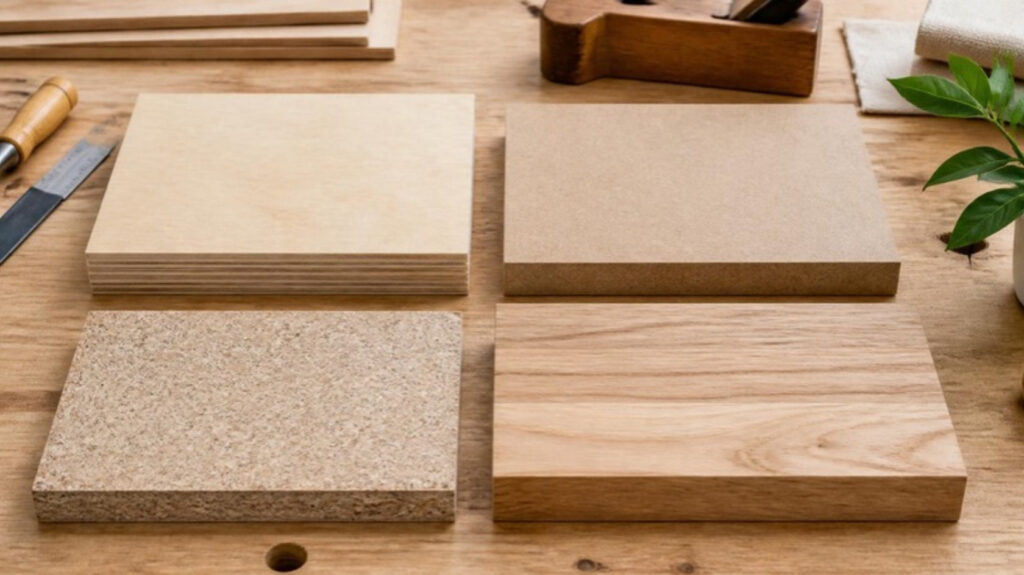
Kitchen cabinets are usually a mix of materials, and each one suits a different part. Plywood keeps its length and width as humidity changes, so it suits boxes and shelves. MDF gives a smooth, grain-free surface for paint, and solid wood suits frames and drawer sides. The rule: judge every material by the part it is used in.
This guide is for homeowners who are comparing cabinet quotes and see these four names on a spec sheet. It covers how the materials behave with moisture, fasteners, stability and finish, and which part of a cabinet each one tends to suit. It does not cover prices, cabinet types such as stock or custom, or countertops, and it does not rank specific products.
Key Takeaways
- A cabinet quote should name the material for each part: box, shelves, door frame, door panel and drawer box. A single word such as “wood” does not tell you enough.
- Solid wood swells and shrinks across its width as indoor humidity changes. At 70°F, the USDA Forest Products Laboratory’s Wood Handbook (2021) puts the moisture content of wood at 6.2 percent in 30 percent relative humidity. In 80 percent it is 16.0 percent.
- Plywood is made of cross-laminated layers, which the Wood Handbook credits with “excellent dimensional stability” and reduced splitting near panel edges.
- According to the Composite Panel Association, MDF has a flat, smooth surface without knots or grain. That surface suits paint.
- Consumer Reports’ cabinet buying guide (September 2016) recommends 3/4-inch plywood shelves and drawers with solid-wood sides, dovetail joints and a plywood bottom. It is construction advice; the organization does not test cabinets at this time.
- In our reading, a stained door needs a solid-wood or wood-veneer surface, because stain lets the grain show. Under paint, the smoothness of the surface matters more than the species.
In This Guide
- What are plywood, MDF, particleboard and solid wood?
- How do the four materials compare on moisture, fasteners and finish?
- Why does solid wood move with humidity?
- Why are painted cabinet doors often MDF?
- Which material belongs in which part of a cabinet?
- Where this comparison reaches its limits
- What to ask about the materials in a cabinet quote
- FAQ
What are plywood, MDF, particleboard and solid wood?
Plywood, MDF and particleboard are panels made from wood that has been cut or broken down and bonded back together. Solid wood is lumber sawn from the log. The three panels differ in the size of the wood inside them: sheets of veneer in plywood, particles in particleboard, fibers in MDF.
| Material | What it is | Where the source says it is used |
|---|---|---|
| Plywood | Layers of wood veneer, with the grain of adjacent layers set perpendicular to one another (Wood Handbook) | Hardwood plywood: “furniture and cabinet panels” where appearance may matter more than strength (Wood Handbook) |
| Particleboard | “Cellulosic particles of various sizes that are bonded together with a synthetic resin or binder under heat and pressure” (Composite Panel Association) | Kitchen cabinets, shelving, countertops, furniture (Composite Panel Association) |
| MDF (medium-density fiberboard) | “Cellulosic fibers combined with a synthetic resin or other suitable bonding system and joined together under heat and pressure” (Composite Panel Association) | Kitchen cabinets, doors, trim moulding, furniture (Composite Panel Association) |
| Solid wood | Lumber sawn from the log, with one grain direction throughout | In cabinets it appears mainly in frames, doors and drawer parts |
Source: USDA Forest Products Laboratory, Wood Handbook, General Technical Report FPL-GTR-282, 2021, chapter 11; Composite Panel Association product pages for particleboard (page modified June 2, 2026) and MDF (page modified July 16, 2026). The solid wood row is our summary.
Two points follow for someone reading a quote. First, particleboard is rarely left bare. The Wood Handbook notes that particleboard in furniture “is typically overlaid with other materials for decorative purposes”. What you see on a cabinet side is usually a veneer, laminate or paint over the panel. Second, each panel name covers a range of grades. The name on a spec sheet tells you the family of the material, and its thickness and grade are still to be asked.
How do the four materials compare on moisture, fasteners and finish?
The four materials differ mainly in three things: how they react to water, how they hold fasteners near an edge, and how they take paint or stain. No one of them leads on every criterion, which is why a cabinet normally combines several.
| Criterion | Plywood | Particleboard | MDF | Solid wood |
|---|---|---|---|---|
| Stability as humidity changes | “Excellent dimensional stability along its length and across its width” (Wood Handbook) | No comparable figure in the sources cited | No comparable figure in the sources cited | Swells and shrinks across the grain (Wood Handbook) |
| Reaction to wetting | Minimal irreversible thickness swelling | The Wood Handbook contrasts plywood with most panels made from particles, which can swell in thickness and stay swollen | No comparable figure in the sources cited | Swells, then shrinks again as it dries |
| Fasteners | Cross layers reduce splitting when fasteners sit near an edge | No comparable figure in the sources cited | No comparable figure in the sources cited | Depends on species and grain direction |
| Finish | Face veneer can be stained | Usually overlaid | Flat, smooth, no grain: suits paint | Shows grain: suits stain |
Our summary of the sources named in each cell.
The moisture row deserves the closest reading. On plywood the Wood Handbook says that, unlike most panels fabricated from particles, it “undergoes minimal irreversible thickness swelling if wetted”. In plain terms, a wet plywood panel tends to return close to its original thickness. A particle-based panel that has swollen can stay swollen. That matters around the sink, the dishwasher and the floor line, where leaks happen.
On fasteners, the same handbook calls plywood “an excellent choice” where fasteners must sit “very near the edges of a panel”. Hinges, drawer guides and assembly screws all sit near panel edges. This guide does not rank the four materials on screw holding or weight. Both vary with the grade of the specific panel, so ask the seller for the manufacturer’s data sheet.
Why does solid wood move with humidity?
Solid wood moves because it takes up moisture from humid air and gives it back to dry air. Its size changes with its moisture content. The fiber saturation point averages about 30 percent moisture content. Below it, the Wood Handbook states, wood “changes dimension as it gains moisture (swells) or loses moisture (shrinks)”.
The movement is uneven. According to the handbook, the largest change runs in the direction of the growth rings (tangentially). About half as much occurs across the rings (radially), and only a slight change occurs along the grain. A board therefore gets wider and narrower through the year far more than it gets longer and shorter.
| Species | Radial shrinkage | Tangential shrinkage |
|---|---|---|
| Northern red oak | 4.0% | 8.6% |
| Sugar maple (hard maple) | 4.8% | 9.9% |
| Black cherry | 3.7% | 7.1% |
Source: USDA Forest Products Laboratory, Wood Handbook, FPL-GTR-282, 2021, chapter 4. Shrinkage from green to oven-dry, as a share of the green dimension.
Those percentages describe drying from freshly cut to completely dry, which does not happen in a kitchen. What happens indoors is a smaller swing. The handbook’s table gives the moisture content wood settles at in 70°F air. It is 6.2 percent at 30 percent relative humidity, 9.2 percent at 50 percent and 16.0 percent at 80 percent. These are general figures, not readings from a particular house, so the range your own kitchen sees may be narrower or wider.
A rough calculation of our own shows the scale. Red oak shrinks 8.6 percent tangentially over about 30 points of moisture content. Assume a seasonal swing of 4 points. A 15-inch-wide flat-sawn panel then moves by roughly 0.17 inch. This is a simplified straight-line estimate, and a real door’s finish and grain orientation reduce it. In our reading, it also explains why a wide solid-wood door panel should be free to move inside its frame rather than glued tight.
Why are painted cabinet doors often MDF?
Painted cabinet doors are often MDF because paint shows every flaw in the surface under it, and MDF offers a uniform surface with no grain. The Composite Panel Association describes the MDF surface as “flat, smooth, uniform, dense, and free of knots and grain patterns”. It adds that the even density allows “intricate and precise machining and finishing techniques”.
The second reason is our reading of the wood movement described above. A door built from solid-wood parts has joints where pieces with different grain directions meet, and those pieces change width with the seasons. A film of paint lying across such a joint can show a fine line there. A door or center panel routed from one piece of MDF has no such joint in that area. Stain, by contrast, soaks into the wood and lets the grain show, so small seasonal lines are less visible.
One independent view points the other way and should be stated. The Consumer Reports guide (2016) advises looking for “a solid-wood frame surrounding solid-wood or plywood panels” and treats an MDF panel as the lesser option. In our reading, that advice fits stained doors well, and the case for MDF applies to painted finishes specifically. If a quote lists MDF doors, ask whether the whole door is MDF or only the center panel.
Which material belongs in which part of a cabinet?
Each part of a cabinet asks for something different. The box has to stay square and hold hardware, and shelves have to resist sagging. Drawer boxes take repeated loads, and doors have to stay flat and carry the finish. The Consumer Reports kitchen cabinet buying guide (updated September 15, 2016) gives part-by-part recommendations. The table below combines them with the material properties already discussed.
| Cabinet part | What tends to fit | Why |
|---|---|---|
| Cabinet box, especially the sink base | Plywood sides and bottom | Minimal irreversible thickness swelling if wetted (Wood Handbook); Consumer Reports favors plywood boxes over veneered particleboard |
| Shelves | 3/4-inch plywood | Consumer Reports: “Lesser-quality 5/8- or 1/2-inch particleboard shelves may sag” |
| Drawer boxes | Solid-wood sides, dovetail joints, plywood bottom | Consumer Reports’ recommendation; it advises against stapled particleboard |
| Stained doors | Solid-wood frame with a solid-wood or veneered panel | Consumer Reports recommends a solid-wood frame around a solid-wood or plywood panel; under stain, the grain is the visible finish |
| Painted doors | MDF, or a solid-wood frame with an MDF center panel | Smooth, grain-free surface (Composite Panel Association); fewer moving joints under the paint, in our reading |
| Dry, lightly loaded parts with a laminate surface | Particleboard | Composite Panel Association lists cabinets and shelving among its uses |
Our summary, combining the Consumer Reports guide (2016), the Wood Handbook (2021) and the Composite Panel Association pages (2026).
The Consumer Reports guide is from 2016, and it states that the organization does not test cabinets at this time. Read its advice as construction guidance, not as current test results. Its recommendations concern parts that carry load or meet water, which is where the differences between materials show up first. A quote with particleboard wall cabinets and a plywood sink base makes that same distinction. It is reasonable to ask a seller whether such a mix is possible.
Where this comparison reaches its limits
A material name alone does not settle how a cabinet will perform, because grade, thickness, edge sealing and assembly matter as well. A thick, well-sealed particleboard panel in a dry wall cabinet and a thin one under a sink are different cases. Plywood itself varies in the number and quality of its layers.
Three limits apply to this guide. It gives no comparable numbers for screw holding or weight, so it does not rank the materials on those points. The Wood Handbook passages on plywood describe panels in general, and a specific cabinet-grade product may differ. And the shrinkage example is a simplified estimate of ours, not a prediction for your doors.
The comparison also does not apply in the same way to every room. A cabinet that stays dry for its whole life may not reveal the difference between two box materials. The differences described here matter in proportion to how much water, load and humidity change a given part will meet.
What to ask about the materials in a cabinet quote
A cabinet quote is comparable with another one only when both name the material for each part. Take the spec sheet and ask the seller to fill in the answers below for every cabinet line you are considering.
- What are the box sides, bottom and back made of, and how thick is each?
- What are the shelves made of, and are they 3/4 inch thick?
- Is the door frame solid wood, and what is the center panel made of?
- For a painted door, is the whole door MDF or only the panel?
- What are the drawer sides and bottom made of, and how are the corners joined?
- Are the edges of particleboard or MDF parts sealed or covered, including the cut edges around plumbing?
- Is the sink base built from the same material as the other boxes?
- Are the composite panels labeled TSCA Title VI compliant?
Write the answers in the same order for each quote. Two quotes that look alike in total can differ on four or five of these lines. Those lines are what you will live with after installation.
Then read each quote part by part instead of looking for one overall material. Put water resistance first for the box and the sink base, thickness first for shelves and joinery first for drawer boxes. For doors, start from the finish you want: stain points to solid wood and veneer, paint to a smooth panel such as MDF. Where a line on the quote leaves the material unnamed, ask for it in writing before you compare totals.
UST Kitchen & Bath has a showroom in Richardson, Texas, and our team brings over 30 years of experience to kitchen and bathroom projects.
Contact UST Kitchen & Bath about the cabinet materials for your kitchen
Frequently Asked Questions
Is cabinet plywood the same as construction plywood?
Not usually. The Wood Handbook (2021) says hardwood plywood is normally used for furniture and cabinet panels, “where appearance may be more important than strength”. Construction and industrial plywood is used “where strength, stiffness, and construction utility are more important than appearance”. Ask which kind a quote means.
Do formaldehyde emission rules apply to finished cabinets?
Yes, in the United States. The Environmental Protection Agency’s formaldehyde emission standards under TSCA Title VI cover hardwood plywood, medium-density fiberboard and particleboard. According to the EPA, they also cover “household and other finished goods containing these products”. After March 22, 2019, composite wood products must be labeled as TSCA Title VI compliant (EPA page updated February 12, 2026).
What does “composite wood” mean on a cabinet spec sheet?
In federal rules, it is the umbrella term for hardwood plywood, MDF and particleboard. The EPA’s formaldehyde standards are written for these “composite wood products”. The term tells you a part is made from one of these panels, not which one, so ask the seller to name the panel for each part.
Sources
- USDA Forest Service, Forest Products Laboratory, Wood Handbook: Wood as an Engineering Material, General Technical Report FPL-GTR-282, 2021. Government research laboratory; chapter 4 (moisture relations, shrinkage and equilibrium moisture content) and chapter 11 (plywood, particleboard, MDF).
- Consumer Reports, “Kitchen Cabinet Buying Guide”, updated September 15, 2016. Independent testing organization; shelf, drawer, door and box recommendations.
- Composite Panel Association, product pages “Particleboard” (modified June 2, 2026) and “Medium Density Fiberboard” (modified July 16, 2026), compositepanel.org. Trade association describing its members’ products; definitions, surface properties and listed uses.
- U.S. Environmental Protection Agency, “Formaldehyde Emission Standards for Composite Wood Products”, epa.gov, updated February 12, 2026. Government agency; products covered and labeling dates under TSCA Title VI.