
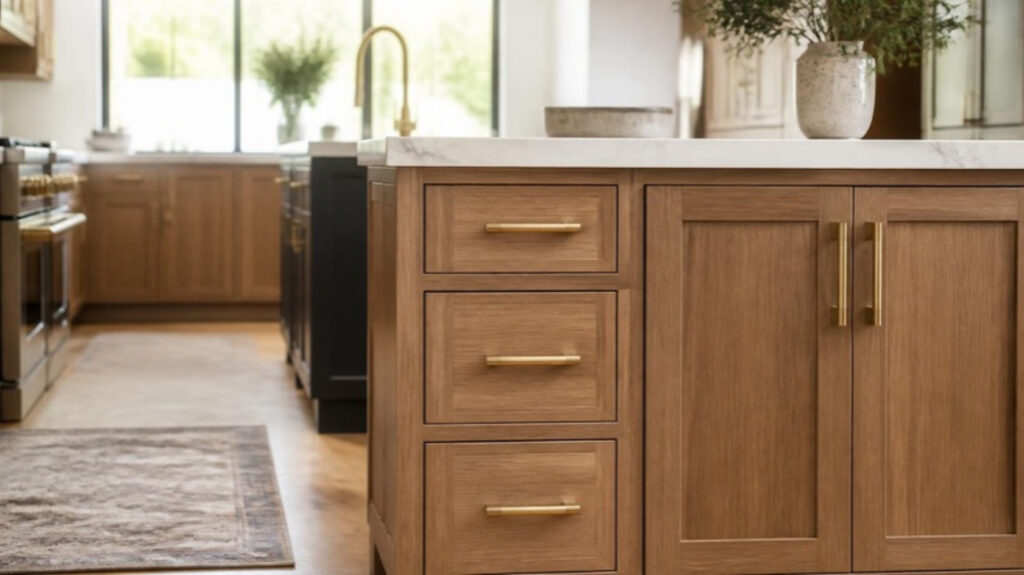
Stock, semi-custom and custom cabinets differ in how much the cabinet adapts to your room. Stock cabinets come in fixed sizes, semi-custom cabinets let you change selected dimensions and features, and custom cabinets are made to your measurements. If standard widths fill your walls, stock is usually enough; if they do not, you need one of the other two.
This guide is for homeowners who are replacing kitchen cabinets and have met these three terms without a clear explanation. It uses U.S. cabinet sizes in inches. It does not give prices, and it covers kitchen cabinets only, not closets or built-in furniture.
Key Takeaways
- Stock, semi-custom and custom describe how a cabinet is sized and ordered. Consumer Reports reported in its 2016 buying guide that some basic models did better in its wear tests than more expensive ones. The type alone does not tell you the build quality.
- Standard base cabinets usually come in widths from 12 to 60 inches in 3-inch steps. Stock cabinets suit walls that those widths can fill.
- Semi-custom cabinets usually fit a kitchen where one or two spots need a different size, finish or storage feature.
- Custom cabinets usually fit a room that is itself unusual: angled walls, very high ceilings, or a design no catalog covers.
- Whichever type you buy, check the box material, the drawer construction, and whether the line is certified to ANSI/KCMA A161.1, the cabinet industry’s performance standard.
- The type alone does not fix the price. Material, door style and construction move the cost within each type, so rely on a written quote for your own layout.
- Measure your walls before you compare the three types.
In This Guide
- What is the difference between stock, semi-custom and custom cabinets?
- Does the cabinet type tell you the quality?
- How do your wall measurements decide the cabinet type?
- How do cost and lead time compare?
- Which cabinet type fits which situation?
- What to ask in a cabinet showroom
- Measure first, then compare cabinets in person
- FAQ
What is the difference between stock, semi-custom and custom cabinets?
Stock, semi-custom and custom cabinets differ in the point at which your kitchen enters the process. A stock cabinet exists before your order does. A semi-custom cabinet is a standard cabinet adjusted for your order. A custom cabinet is not made until your kitchen has been measured and drawn.
| Stock | Semi-custom | Custom | |
|---|---|---|---|
| Sizes | Fixed, from the line’s list | Standard sizes, with selected changes | Made to your measurements |
| What you choose | Door style and finish from a limited range | A wider range of styles and finishes, plus options such as depth and storage inserts | Dimensions, material, finish and interior layout |
| How gaps are handled | Filler strips | Fewer fillers, where the line allows resizing | Cabinets made to the wall length |
| Fits best when | Standard widths fill your walls | One or two spots need something different | The room itself is irregular |
Our summary of how the three terms are generally used. What a specific line allows varies by manufacturer.
A filler strip is a narrow panel, finished to match the doors, that closes the gap between a cabinet and a wall. Fillers are normal in most kitchens. The question is how many you need and how wide they are.
With semi-custom cabinets, the list of what can be changed matters more than the label. That list differs from one cabinet line to the next. Ask to see it before you assume a size or feature is available.
Does the cabinet type tell you the quality?
Not on its own. The cabinet type describes how a cabinet is sized and ordered, and testing suggests it does not predict how well the cabinet holds up. The Consumer Reports kitchen cabinet buying guide was updated in September 2016. It reports that its past tests “found some basic models that perform better in our wear tests than more expensive models”. The guide is several years old, and the models it tested are no longer the ones on sale. Its point is about method: judge the cabinet in front of you.
The same guide names the construction details to look for, and they apply to all three types:
| Part | What Consumer Reports recommends |
|---|---|
| Drawers | Solid-wood sides, dovetail joinery and a plywood bottom, instead of stapled particleboard |
| Drawer hardware | Full-extension drawer guides |
| Shelves | 3/4-inch plywood; thinner particleboard shelves may sag |
| Doors | A solid-wood frame around a solid-wood or plywood panel |
Source: Consumer Reports, kitchen cabinet buying guide, updated September 15, 2016.
A second check is certification. Ask whether the cabinet line is certified to ANSI/KCMA A161.1.
ANSI/KCMA A161.1 is the Performance and Construction Standard for Kitchen and Vanity Cabinets. The Kitchen Cabinet Manufacturers Association (KCMA) maintains it, and it is approved through the American National Standards Institute (ANSI). An article by Larry Adams of Woodworking Network, published on KCMA’s site in January 2023, describes these tests:
| Part tested | What the test does |
|---|---|
| Shelves and cabinet bottoms | Loaded at 15 pounds per square foot for seven days |
| Wall cabinets | Loaded gradually to 600 pounds |
| Doors | Opened and closed through a 90-degree swing for 25,000 cycles |
| Drawers | Loaded at 15 pounds per square foot and operated for 25,000 cycles |
| Finish | Held at 120°F and 70 percent relative humidity for 24 hours; exposed to substances such as vinegar and coffee for 24 hours and to mustard for one hour |
Source: Larry Adams, “Cabinets Certified to Last”, KCMA, January 17, 2023. Selected tests as described in that article. Ask the seller which edition of the standard a line is certified to.
Certification does not prove that a cabinet is the best one available. It tells you the line has passed a known set of durability tests. A cabinet without it is not necessarily weak, but then you are relying on the seller’s description alone.
How do your wall measurements decide the cabinet type?
Your wall measurements decide the cabinet type when standard widths cannot fill a wall without wide fillers. Stock cabinets work when your wall lengths can be covered with standard widths and small filler strips. When they cannot, you need a line that can be resized, which means semi-custom or custom.
A consumer guide to standard kitchen cabinet sizes (updated August 31, 2026; see Sources) gives these figures:
| Cabinet | Standard dimensions |
|---|---|
| Base cabinet | 34½ inches high, 24 inches deep, 12 to 60 inches wide, usually in 3-inch steps |
| Wall cabinet | Standard heights of 12, 18, 30 and 36 inches, with 42 and 48 inches also available; most commonly 12 inches deep |
| Tall cabinet | Usually 84 to 96 inches high |
Source: consumer guide to standard cabinet sizes, updated August 31, 2026 (see Sources). A specific line’s size list may differ.
A short example shows how the 3-inch step works. Suppose the wall between your range and the corner is 40 inches long. The widest standard combination that fits is 39 inches, for example a 21-inch and an 18-inch cabinet, and a 1-inch filler closes the rest.
Now suppose the same wall is 44 inches and you want one wide drawer cabinet there. A 42-inch standard cabinet leaves 2 inches for fillers. A cabinet made at 44 inches, from a semi-custom line that allows that width or from a custom maker, uses the whole wall. Whether those 2 inches matter is your decision, and the example shows what the more flexible type would give you.
Before you visit a showroom, measure every wall that will carry cabinets and the ceiling height. Note the position of windows, doors, plumbing and the range hood. Approximate numbers are enough for a first conversation. Exact measurements are needed before an order, so ask who takes them.
How do cost and lead time compare?
The cabinet type alone does not fix the price. Material, door style and construction move the cost within each type, which is why two quotes for the same type can be far apart. This guide gives no prices for that reason: a written quote for your own layout is the reliable figure.
Lead time works the same way. One consumer guide (updated August 1, 2026; see Sources) lists semi-custom delivery at one to two weeks after ordering. The figure for any line depends on the manufacturer and the order. As a general rule, a cabinet which already exists in a warehouse can ship sooner than one that still has to be made. Ask each seller for the current lead time in writing.
Which cabinet type fits which situation?
Match the cabinet type to the problem you are solving. A regular room whose walls suit standard widths points to stock. One or two places that standard sizes do not cover point to semi-custom. An irregular room points to custom.
| Your situation | Type that usually fits | Why |
|---|---|---|
| Every wall works with standard widths and small fillers | Stock | The sizes you need are already on the line’s list |
| One odd wall, a deeper cabinet or specific storage inserts | Semi-custom | Selected dimensions and features can be changed |
| You want a finish or door style a stock line does not offer | Semi-custom | The range of styles and finishes is wider |
| Angled walls, very high ceilings or an unusual floor plan | Custom | Every dimension is made for the room |
| A design that has to match existing woodwork or furniture | Custom | Material and finish are chosen for the project |
The three types can also be combined in one kitchen. For example, you might use standard cabinets along the straight walls and add one made-to-measure piece where the room demands it, such as an island or a cabinet around a structural column. If you plan this, first confirm that the door style and finish of the two lines can be matched closely. A visible difference between them is hard to correct after installation.
When is custom more than your kitchen needs?
Custom is more than your kitchen needs when standard sizes already fit the room. In a rectangular kitchen with ordinary ceiling height, there may be nothing for a made-to-measure cabinet to solve. If a custom quote comes in higher than a semi-custom one, ask what the difference buys in your specific room. Then compare that with what the same amount would do for drawer construction, shelf material or the countertop.
The opposite mismatch exists too. Stock cabinets in a room that does not suit standard widths can mean wide filler strips and corners that go unused. If your measurements show more than one place where standard sizes fail, treat that as a reason to look at lines that can be resized.
What to ask in a cabinet showroom
In a showroom you can open the doors and pull the drawers, which a catalog cannot offer. With your wall measurements and a few photos of the kitchen at hand, ask these questions about each cabinet line you are shown:
- What are the box sides, bottom, back and shelves made of, and how thick are they?
- Are the drawer boxes dovetailed, and do the guides extend fully?
- Is this line certified to ANSI/KCMA A161.1, and to which edition?
- Which dimensions can be changed on this line, and in what steps?
- What is the current lead time from order to delivery?
- What does the warranty cover, and for how long?
- Who measures the kitchen, and who installs the cabinets?
- Can I see a drawing of my layout before I order?
Write the answers down for each line. With the same eight answers side by side, you compare cabinets on what they are made of and what they can do, not on the label.
Measure first, then compare cabinets in person
Measure your walls, then look at real cabinets with those numbers in hand. Where standard widths fill the walls, start with stock and put your attention on construction. Where one or two spots need a different size or feature, look at semi-custom lines and their option lists. Where the room is irregular, ask for a custom design.
This guide has two limits. It gives no prices, and its lead-time information is general. It does not replace a written quote and a confirmed delivery date. It also describes how the three terms are generally used, and a specific manufacturer may draw the lines differently.
UST Kitchen & Bath has a showroom in Richardson, Texas, and our team brings over 30 years of experience to kitchen and bathroom projects.
Contact UST Kitchen & Bath about your kitchen cabinets
Frequently Asked Questions
Is ready-to-assemble (RTA) the same as stock?
Not exactly. Ready-to-assemble describes how a cabinet is shipped: flat-packed and put together on site. Stock describes how it is sized. An RTA cabinet is usually a stock cabinet, but a stock cabinet can also arrive assembled.
What if my ceiling is higher than standard wall cabinets?
Standard wall cabinet heights run from 12 to 36 inches, with 42 and 48 inches also available, according to the size guide cited above. Above that, the space is usually closed with a second row of cabinets, trim, or cabinets made to height.
How can I tell whether a cabinet line is KCMA certified?
The KCMA article cited above names the KCMA A161.1 Quality Certification Seal as the mark of a certified line. If you do not see the seal, ask the seller for the certification and the edition of the standard. KCMA’s own website also offers a search for certified companies.
Sources
- Consumer Reports, kitchen cabinet buying guide, updated September 15, 2016. Independent testing organization; construction features and test observations.
- Larry Adams (Woodworking Network), Cabinets Certified to Last, published on the Kitchen Cabinet Manufacturers Association site, January 17, 2023. Industry association source describing its own certification program.
- Bob Vila, guide to standard kitchen cabinet sizes, by Tom Scalisi, updated by Theresa Clement, August 31, 2026. Consumer guide; cabinet dimensions.
- Angi, Custom vs. Semi-Custom Cabinets, by Audrey Bruno, updated August 1, 2026. Commercial home-services guide; cited for its lead-time figure only.